





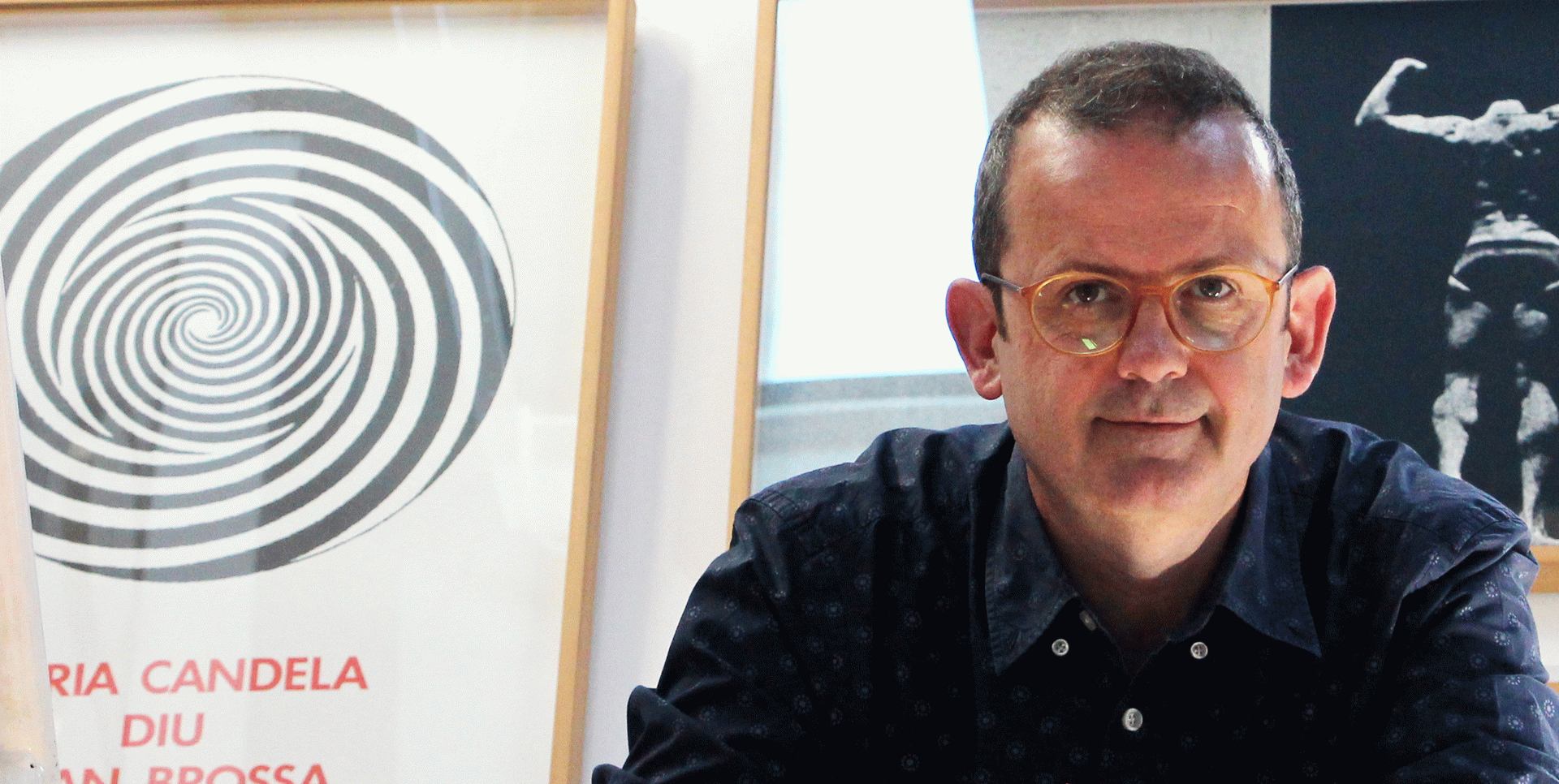
The Disseny Hub Barcelona magazine interviews Pau de Solà-Morales about the current state of architecture in the city, and his career as president of ArquinFAD and director of EINA "an incredibly special school which combines an impressive cultural and artistic trajectory with a commendable future ahead of it".
We reproduce the Disseny Hub Barcelona interview with this architect specialising in design, creativity, and the use and application of information technologies to architecture, who has been involved in research projects on heritage and the city, and holds a degree in architecture and urban planning from the ETSAB (1993), a Master's degree in Design and a PhD in Design from Harvard University (2000).
You graduated with a degree in architecture and urban planning from the ETSAB in 1993, and your professional trajectory has not stopped since then. What led you to become the Director of EINA and the Chairmanship of ArquinFAD?
My career, like that of many others, has taken many turns. After graduating in Barcelona, I worked as an architect for a few years, but I felt the need to gain further academic knowledge on one of my passions: information technology and ICT applied to design and architecture. Between 1996 and 2000, I graduated with a Master and Doctorate in Design at Harvard University, thanks to a Fulbright grant.
When I came back from the United States, I spent many years travelling here and there, and I got to work in various offices and firms. Finally, in 2006, I became a lecturer at Rovira i Virgili University’s School of Architecture, and from there I went on to become the Head of Studies and later, the Director.
After so many years of teaching and intense work in the field of architecture, accepting the Chairmanship at ArquinFAD and winning the contest for the directorship at the EINA school, casually rounded things off nicely. These are two great challenges, but as you can see, facing difficulties appeals to me... I hope I’ll be up to it!
What are EINA’s differential traits that have made it become a benchmark in teaching design?
EINA is an incredibly special school which combines an impressive cultural and artistic trajectory with a commendable future ahead of it. I think that its secret has been that it has always aimed to be a leader in pedagogy and design. The school has constantly maintained high-quality teaching combining design, art, thinking and humanities, and after more than 50 years, we are renewing ourselves once again to continue at the forefront for another 50 years.
How do you convey to the students the importance of including social, accessibility and sustainability criteria in their design projects?
The teachers are an essential channel in conveying to the students the importance of including social and sustainability criteria in their design projects. So in this process, the teachers are the most important part! At EINA, the entire teaching staff is professional. These values are well established amongst our teachers. Bear in mind that students learn design in the classroom through “osmosis”, working closely alongside and with professionals. They pick up everything!
What type of work is carried out at ArquinFAD? What are its goals?
ArquinFAD works mainly to promote and recognise “good” architecture and interior design. It does so through its awards and with a series of activities which aim to give the awarded works and finalists greater relevance. It is a complex and quite long-standing mechanism, bestowing subtle but effective recognition of quality.
How do you rate the fact that ArquinFAD is incorporated into the Design Hub and connected with the other entities that form part of it?
We are very lucky that the Design Hub took us in a few years ago, and that it has put us alongside other entities such as the Barcelona Design Centre and the Design Museum itself. Similarly, we still all have to work hard to ensure that this close relationship be as successful as possible, since Barcelona has great potential in design, and we are right at the beginning of the “joining of forces” to become an international benchmark.
You were a member of the jury for the FAD Awards for Architecture and Interior Design in 2018. How are these awards rated and what do current architectural projects need to have to enter?
The FAD Awards for Architecture and Interior Design are the oldest awards of the Iberian Peninsula, and practically the oldest in the Europe and the world. This makes them highly prestigious and recognised by everyone. Thus, due to this prestige, the members of the jury are very proud of their role. They work hard to guarantee the quality of the final projects and the winners, and for this reason, the prize-winning projects are recognised by the public and by the profession as works of great value. It is a virtuous circle that really has to be looked after! Luckily, both in our country and in Portugal, the architecture and interior design is of a remarkably high quality making our job easier, but at the same time making it more difficult for the jury!
In 2026 Barcelona will be the World Capital of Architecture. What’s so special about the city’s architecture?
Barcelona is already a world capital of architecture! As it has been producing examples of talent and good architectural practices for centuries, many of which are well-known and others which are yet to be discovered! And it will continue doing so. It will also be good to hold the official title for some time, and I hope it doesn’t end up trivialising or treating the wonderful urban and architectural heritage we have lightly.
How do you rate the architectural projects in the city such as the one in Les Glòries and the commitment to 22@?
Glòries is a highly complex project: as an urban area, or as a “plaça” (square), if it can be described as such, it requires intense work in the densification and in the definition of its perimeters, which is currently very extensive. The decision to create a park inside it is controversial. However, depending on how you look at it, it is understandable and very much in line with the messages that have to be conveyed.
As regards 22@, which has Glòries as its entranceway, it is still an area of the city which is yet to be discovered. It’s exciting when cities open up some doors and they discover that they have a whole district to transform, inhabit and change. This is the case in 22@: a district full of expectations and opportunities. The project that is being carried out there has to be up to the mark.
Your latest publication is “Arquitectura, crisis, crítica radical” (Architecture, Crisis, Radical Criticism). Can you tell us what this paper is about?
Arquitectura, crisis, crítica radical is a commentary and reinterpretation of a text by Manfredo Tafuri from the 1960s. In that text, Tafuri denounced that architecture and urban planning had become tools of the Capital, and he forecast their demise. It is a very current topic, because there are people who think the same today and they accuse architecture and urban planning of being the root of all evils. But ultimately, they are very powerful tools we have in creating a city. The city is there outside, and it will continue to be there for many years to come.
Proceedings