




Creating as a Situated and Relational Practice
This capsule proposes understanding creativity as a situated process that emerges from the continuous relationship between people and the world of which they are a part. It offers conceptual, methodological, and practical tools for approaching research, creative, and design processes from a situated and relational perspective.
Academic Director
Pilar Cortada
Researcher in creativity and Director of Eina Obra.
Traditionally, creativity has been understood as an individual capacity aimed at producing original ideas. However, advances in contemporary physics, ecological psychology, systems theory, new materialisms, and other strands of contemporary thought are profoundly transforming our understanding of how novelty emerges. Rather than viewing reality as a collection of independent entities, these perspectives understand it as a network of dynamic and interdependent relationships.
Ecosystemic Creativity brings this paradigm shift into the field of creative practice. This module proposes understanding creativity as a situated and relational process that emerges from the continuous relationship between people and the world of which they are a part. Through conceptual, methodological, and practical tools, it provides participants with resources to apply this perspective to research, creative, and design processes.
To understand creativity as a relational practice and develop the conceptual and practical tools to perceive, explore, and respond to the action possibilities that emerge through interaction with the environment.
Ignasi Aballí, visual artist working within conceptual practices.
Paula Bruna, environmental scientist and artist.
Ada Castells, writer and journalist.
Claudia Claremí, visual artist and filmmaker.
Pilar Cortada, creativity researcher and Director of Eina Obra.
Antía Iglesias, artist and researcher.
Estampa, an artistic collective of programmers, filmmakers, and researchers.
Angélique Lebert, researcher at the intersection of Experimental Cognitive Psychology and Neuroscience.
Laura Vilar, dancer, educator, creator, and researcher in dance and movement across educational, artistic, and performative contexts.
Eulàlia Rovira, artist, educator, and researcher.
The capsule consists of nine three-hour sessions delivered over the course of three months. Each session combines theoretical reflection, the analysis of key references, and hands-on experimentation to explore, through experience, how attention, perception, and the relationship between people and their environment shape creative processes. Artistic practice functions as a laboratory for exploring new ways of attending to, perceiving, and responding to the environment.
The capsule follows a modular and progressive structure, allowing participants to develop its contents gradually through a combination of conceptual frameworks, practical exercises, and collective discussion. Between sessions, participants undertake practices of observation, exploration, and experimentation designed to integrate the concepts explored into their own research, creative processes, and professional contexts.
Designed for people working in research, creative practice, design, education, culture, science, or innovation who wish to expand their understanding of creativity from an ecosystemic perspective.
Capsule 1 · Ecological Creativity: Situated, Distributed, and Relational
Date: October 27
Faculty: Pilar Cortada and Antía Iglesias
The first session establishes the conceptual framework of the capsule by introducing the main perspectives underpinning ecosystemic creativity. Rather than understanding creativity as an individual capacity located in the human mind and its cognitive processes, the session approaches it as an ecological, situated, and distributed process that emerges through the relationships between people, materials, and environments. Building on this conceptual shift, participants will explore how attention, perception, and action possibilities shape creative processes.
Capsule 2 · Resonating
Date: November 3
Faculty: Pilar Cortada and Laura Vilar
The second session explores the role of sensory, affective, and intellectual attention in the emergence of creativity. It examines how the ways we attend to, perceive, and allow ourselves to be affected by the world shape our ability to recognise new action possibilities. Through exercises in observation, perception, and experimentation, participants will develop more open, sensitive, and receptive ways of relating to their environment.
Capsule 3 · Coexisting
Date: November 10
Faculty: Pilar Cortada and Paula Bruna
To coexist means to exist alongside other people, living beings, materials, and environments, recognising that all existence unfolds in relation to what surrounds it. This session explores how creativity emerges through the dynamic relationship between people and their environment, paying particular attention to the active role of context and the action possibilities it affords. Through experimentation with different materials, situations, and contexts, participants will expand their ability to perceive, explore, and respond to the possibilities that emerge through interaction with their environment.
Capsule 4 · Contaminating and Being Contaminated
Date: November 17
Faculty: Pilar Cortada and Eulàlia Rovira
Creative processes do not follow a linear progression but are continually transformed through the relationships, interferences, and encounters that unfold throughout their development. This session explores how every creative practice involves affecting and being affected by people, materials, technologies, and environments. Drawing on the work of Anna Tsing, it approaches "contamination" as a constitutive condition of creation, in which every encounter reshapes the way we perceive, think, and act, opening up new action possibilities.
Capsule 5 · Unlearning
Date: November 24
Faculty: Pilar Cortada and Angélique Lebert
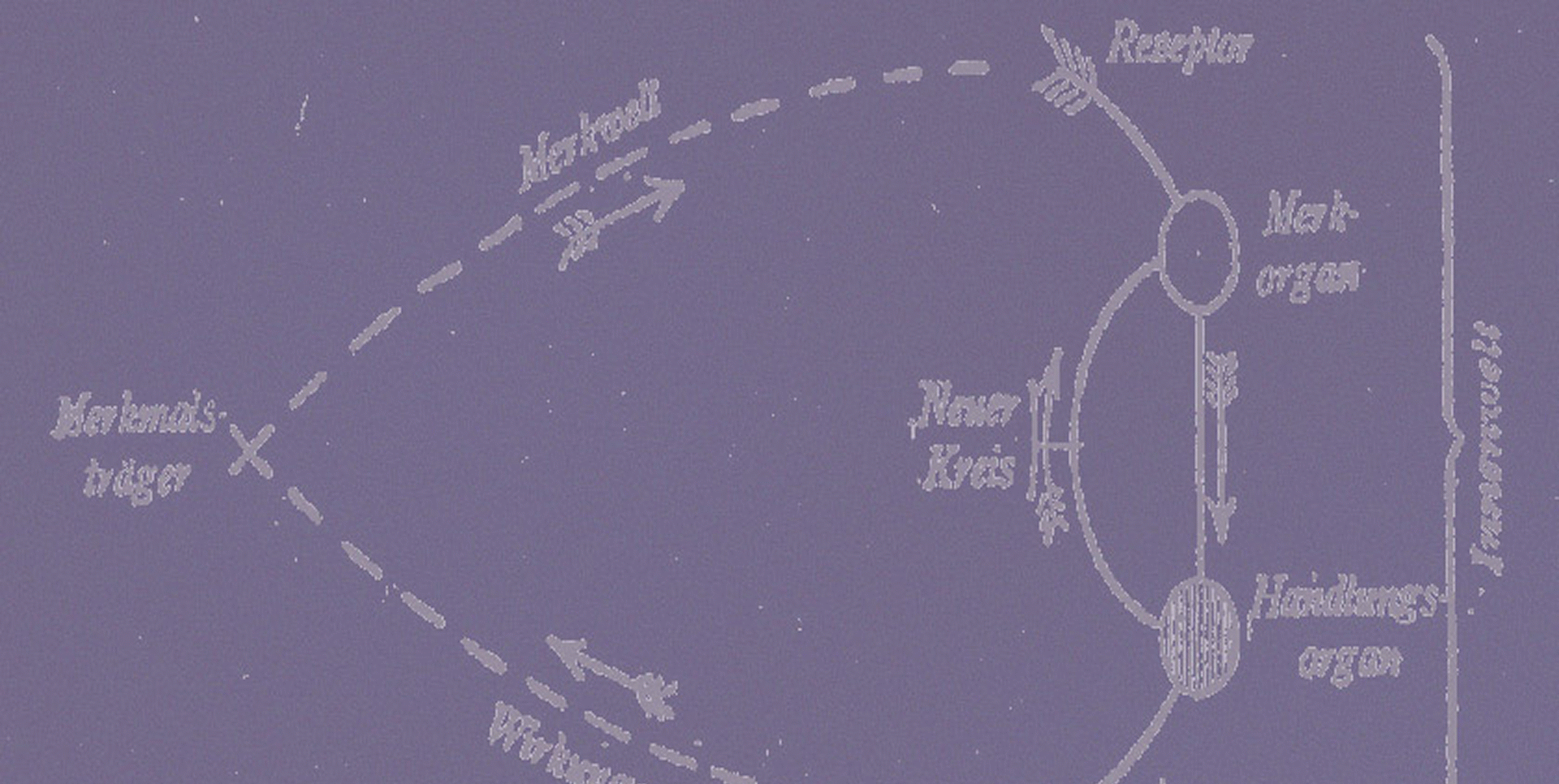
We perceive the world through categories, habits, and modes of attention that shape what we are able to recognise as meaningful. This session explores how these perceptual structures configure our Umwelt, or meaningful environment, and, with it, the action possibilities we are able to perceive. Through a series of exercises, participants will suspend habits, expectations, and preconceptions in order to make space for new ways of attending to, perceiving, and responding to their environment.
Capsule 6 · Problematizing
Date: December 1
Faculty: Pilar Cortada and Marc Padró (Estampa Studio)
Problematizing means questioning what we take for granted and transforming seemingly resolved situations into new questions. This session introduces different strategies for identifying assumptions, shifting interpretive frameworks, and opening up new action possibilities.
Capsule 7 · Exploring
Date: December 9
Faculty: Pilar Cortada and Ignasi Aballí
Exploring involves actively directing attention towards the environment in order to discover relationships, patterns, and possibilities that have previously gone unnoticed. Rather than a means of achieving a predetermined goal, exploration is a practice of perceptual openness that expands our capacity to perceive, learn, and create.
Capsule 8 · Attending Aesthetically
Date: December 15
Faculty: Pilar Cortada and Claudia Claremí
This session approaches aesthetic attention as a perceptual disposition that expands our capacity to attune to the environment and perceive new action possibilities. Through practices of observation and experimentation, participants will develop more open, sensitive, and receptive modes of attention that foster a more attentive relationship with a more-than-human world.
Capsule 9 · Articulating
Date: December 22
Faculty: Pilar Cortada and Ada Castells
This session begins from the idea that articulation is itself a creative act. By giving form to an idea through words, images, or gestures, we do more than communicate it—we transform it. Articulation thus serves a dual purpose: it enables exchange with others while also helping us clarify, refine, and expand our own thinking. Through experimentation with different modes of articulation—spoken, written, visual, and performative—the session explores how these modes not only communicate ideas but also generate new possibilities for understanding and creation.
The fee for the capsule is €702.
Receive a 10% discount on all capsules for registrations completed by 1 September 2026. Enter the code EARLYBIRD2026 when registering.