




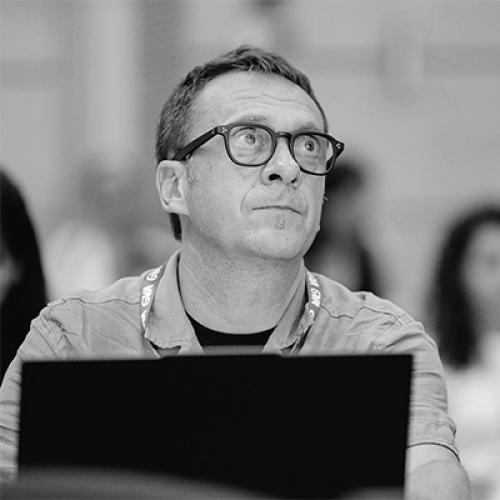
Alberto Barberá Duelo studied Technical Telecommunications Engineering but has never worked professionally in this field. Instead, after discontinuing his studies, he spent fifteen years working in audiovisual technology for the performing arts, specialising in stage lighting and audiovisual integration. In 2012, he moved to Madrid to undertake the Master’s Degree in Architectural Lighting Design at the Higher Technical School of Architecture of Madrid (UPM). He withdrew from his professional activity on stage in 2017, the same year he was awarded the Barcelona Theatre Critics’ Award for his audiovisual creation work on Birdie, a production by Agrupación Señor Serrano.
Teaching / Research
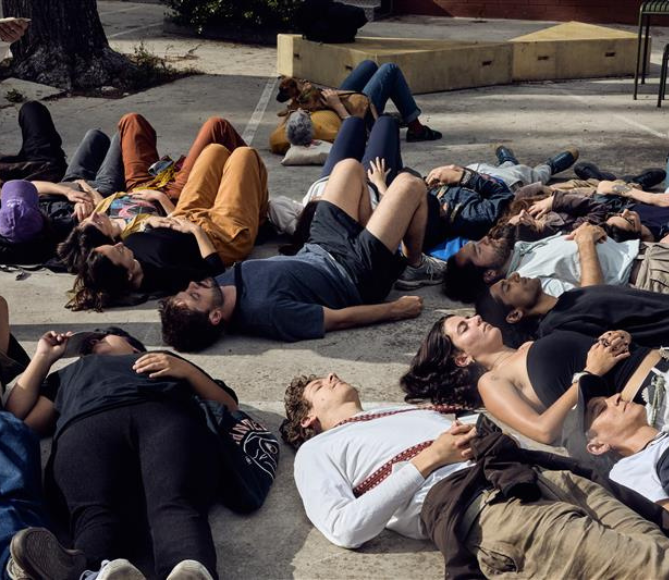
In 2013, he co-founded the research and experimentation collective focused on public space lighting, Lupercales, together with Irene Bas, Paolo Portaluri and Álvaro Valdecantos.
From its inception, Lupercales has been devoted to questioning the priorities that have traditionally guided urban lighting projects, particularly those centred on public space, drawing inspiration from New Urbanism and the tactical urbanism movement.
He has designed, produced and led workshops on stage lighting, public space lighting and co-design processes at institutions such as Sala Beckett, La Caldera, the Polytechnic University of Madrid, the Polytechnic University of Catalonia, Casal dels Infants del Raval, and the Städelschule of Architecture in Frankfurt, as well as in contexts such as the LlumBCN Festival and the Edu Light Festival in Timișoara.
He has participated as a speaker at specialised lighting design conferences such as IALD Enlighten Europe (Berlin, Valencia) and the Light Symposium (Wismar, Copenhagen), as well as in other forums such as Healthy City Design (Liverpool).
His personal project, natura|urbana, focuses on the evolution of urban and exterior lighting, addressing its socio-cultural, environmental and health-related aspects. This line of research continues through his current co-leadership of the Urban-Centric Lighting Working Group within the Catalonia Lighting Cluster (CICAT), where he is responsible for coordinating innovative urban and green space lighting projects in collaboration with various companies in the lighting sector.
Professional activity
As Head of Lighting Projects at the studio Anoche Iluminación Arquitectónica, he has been responsible for implementing the BIM methodology, which is essential for leading and coordinating large-scale projects. He has acted as Main Designer, BIM Coordinator and Project Manager on complex commissions, such as the refurbishment of Camp Nou, the construction of the Mohammed VI Tower in Rabat, the extension of the La Maquinista Shopping Centre in Barcelona, the Dar Essalam Shopping Centre in Rabat, and the CaixaResearch Institute.