

Ecosystemic Creativity: fostering creativity through dynamic interaction with the environment
Course designed for teams and individuals looking to enhance their creative skills and confidence through an approach that emphasizes the importance of interaction with the environment to generate, explore, and articulate ideas. Facilitated by renowned creative professionals from various disciplines, the course fosters creative thinking, flexibility, exploration, and receptivity, using artistic practice as its foundation.
→ Registration
If you are part of the EINA community, enjoy a 15% discount by entering the code COMUNIDADEINA2025 at the time of registration.
→ Download the information ↧ (Spanish version)
The course is aimed at teams and individuals who wish to be more creative and do so in a way that is more respectful of the environment and others.
The course consists of nine training sessions in the afternoon, distributed over three months and totalling 27 hours. The sessions are facilitated by renowned creative agents from various disciplines. Art is used as a vehicle for learning and as a means to develop perception protocols that improve attention, inviting participants to explore how we observe, relate, and respond to our human, non-human, material, and discursive environment.
The course structure is modular and progressive, allowing participants to advance gradually from theoretical understanding to practical application. Each capsule is designed to facilitate the integration and application of acquired knowledge, offering a dynamic and effective learning experience. During the week, participants do practical work to consolidate what they have learned. In addition, the application of skills and knowledge in real contexts is encouraged, ensuring a smooth transition from theory to practice.
The capsules will take place on Tuesdays, from 14 October to 9 December, from 5:30 pm to 8:30 pm.
Capsule 1. Ecological creativity: situated, distributed and relational
Tuesday, 14 October, from 5:30 pm to 8:30 pm
Aníbal G. Arregui
Capsule 2. Resonate
Tuesday, 21 October, from 5:30 pm to 8:30 pm
Anna Roblas
Capsule 3. Coexist
Tuesday, 28 October, from 5:30 pm to 8:30 pm
Paula Bruna
Capsule 4. “Contaminate” and allow oneself to be “contaminated”
Tuesday, 4 November, from 5:30 pm to 8:30 pm
Eulàlia Rovira
Capsule 5. Unlearn
Tuesday, 11 November, from 5:30 pm to 8:30 pm
Angélique Lebert
Capsule 6. Problematise
Tuesday, 18 November, from 5:30 pm to 8:30 pm
Estampa
Capsule 7. Explore
Tuesday, 25 November, from 5:30 pm to 8:30 pm
Ignasi Aballí
Capsule 8. Aesthetic attention
Saturday, 29 November, from 8:30 am to 2:30 pm
Claudia Claremi
Capsule 9. Articulate
Tuesday, 9 December, from 5:30 pm to 8:30 pm
Ada Castells
Ignasi Aballí, visual artist engaged in conceptual practices.
Aníbal G. Arregui, researcher and lecturer in anthropology.
Paula Bruna, environmental scientist and artist.
Ada Castells, writer and journalist.
Claudia Claremi, visual artist and filmmaker.
Pilar Cortada, researcher in creativity and director of Eina Obra.
Estampa, artistic collective of programmers, filmmakers and researchers.
Angélique Lebert, researcher at the intersection of Experimental Cognitive Psychology and Neuroscience.
Anna Roblas, dancer, educator, creator, and researcher in dance and movement, she has developed her practice in a variety of educational and performative contexts.
Eulàlia Rovira, artist, educator, and researcher.
The programme costs €700 (15% discount for the Eina community).
Discounts
*You’ll get a 15% discount on upcoming courses as a benefit of being part of the Eina community.
*If you bring another person, both of you will receive a 10% discount on the course. Contact eina.obra@eina.cat
to get your personalized code.
Scholarships
Eina Obra has a talent program and offers a 100% scholarship covering the course fee for each program.
To apply, send us an email at eina.obra@eina.cat. You’ll need to include your portfolio/CV and a motivation letter.
The sessions will be facilitated by Pilar Cortada, Doctor of Philosophy, whose research addresses a situated, distributed, and relational concept of creativity focused on what she calls “aesthetic attention,” along with renowned creative agents from various disciplines:
Date: Tuesday, 14 October, from 5:30 pm to 8:30 pm
Location: Eina Bosc (Room B0)
Guest: Aníbal G. Arregi. Researcher and lecturer in the Department of Social Anthropology at the University of Barcelona. Inspired by ethnographic fieldwork ranging from the Amazon to Europe, his research focuses on the critique and deconstruction of key concepts underpinning Western technoscience. His scholarly work highlights the limitations and ethnocentric biases embedded in notions such as “technology”, “ecology”, “species”, and “intelligence” — concepts he seeks to re-examine through a pluralistic epistemology. While his research is mostly published in specialised academic journals, his book Infraespecie: del fin de la naturaleza al futuro salvaje (Alianza, 2024) presents some of these ideas in a format accessible to a broad audience.
The first capsule aims to establish the conceptual foundation of the course, introducing the key theories that underpin it. We will explore the concept of ecosystem creativity, moving away from conventional explanations that tend to focus on the human mind and its cognitive processes. We will define creativity as a situated and distributed ecological process that emerges not so much from the manipulation of decontextualised representations, but through an organism’s interaction with its performative environment and how it addresses and relates to it.
Date: Tuesday, 21 October, from 5:30 pm to 8:30 pm
Location: EINA Bosc (Classroom B0)
Guest: Anna Roblas. Dancer, educator, creator, and researcher in dance and movement, she has developed her practice in a variety of educational and performative contexts. Trained in classical dance, dance pedagogy, choreography, and educational research with a focus on art, body, and movement, she is certified as a Somatic Movement Educator by the School of Body-Mind Centering®. She has worked on projects with Sol Picó, Teatre Lliure, Festival Grec, Norrdans, and Temporada Alta, and was a board member of APDC and founder of the DERIVAT collective. Her research focuses on the body that experiences, learns, and dissolves, through two main lines: CHOQUE, an exploration of death dances and the transformation of bodies under extreme stress, and EMBODIED NARRATIVE(S), a study of the embodied experience of dance educators while engaging in oral discourse. Since 2008, she has been a faculty member at the Institut del Teatre of Barcelona, combining teaching with coordination and research.
The second capsule focuses on understanding that creativity arises from the sensory, affective, and intellectual attention given by an organism during its interaction with the world and in search of opportunities for action. We will explore how sensory and bodily experiences influence our understanding of and relationship with the world around us.
Date: Tuesday, 28 October, from 5:30 pm to 8:30 pm
Location: Bosque de Collserola
Guest: Paula Bruna. Holds a PhD in Fine Arts (University of Barcelona) and both a Bachelor's and a Master's degree in Environmental Sciences (Autonomous University of Barcelona). As an environmental scientist and artist, Paula explores ecological environments from non-human perspectives, combining science, speculative fiction and artistic practice. Her research has been presented at national and international conferences, in specialised publications and in workshops. Her artistic work has been exhibited in Austria, Germany and Colombia, as well as in prominent venues across Spain, including MEIAC (Badajoz), the Palace of the Counts of Gabia (Granada), the CCCC (Valencia), La Capella (Barcelona), and Arts Santa Mònica (Barcelona), among others. She has received support from various artistic research grants and programmes, such as the Guasch-Coranty Grant (UB), OSIC funding (Government of Catalonia), CREA Grants (Barcelona City Council), and the 2023 Leonardo Grant from the BBVA Foundation for researchers and cultural creators.
Coexisting means existing at the same time as one or more other things: harmony, cohabitation, simultaneity, etc. This capsule focuses on exploring how creativity arises from the dynamic interaction between an individual and their environment. The main objective is to develop an awareness of the performativity of the environment or field in which we act, as well as the opportunities for action that it offers. Participants are encouraged to explore, manipulate, and experiment with a variety of materials to expand their creative horizons.
Date: Tuesday, 4 November, from 5:30 pm to 8:30 pm
Location: EINA Bosc (Classroom B0)
Guest: Eulàlia Rovira. Holds a degree in Fine Arts and a postgraduate diploma in Art in Context from the UdK Berlin. Her work examines how certain ways of perceiving and ordering the world become inscribed in bodies, environments, and language. Through installations, sculptures, and performances, she has explored questions such as gravity, vision, surface, and inert matter, proposing a perceptual plasticity resistant to fixed certainties. Recently, she has been awarded the Grant for Artistic Creation, Research, and Innovation from the Generalitat (2025), the Barcelona Crea Grant, and the GAC Award (2020). Her work has been shown at Fundació Joan Brossa (2025), Centre d’Arts Santa Mònica (2023), Girona Cathedral – Bòlit Centre d’Art Contemporani (2022), MACBA (2021), Fabra i Coats (2020), ethall (2020), and Twin Gallery (Madrid, 2020). Since 2013, she has collaborated with artist Adrian Schindler, with whom she shares a concern for displacing both the eye that sees and the voice that narrates.
Creative processes do not follow a linear and structured progression; they are subject to advances, adjustments, setbacks, leaps, and changes. This is because they feed on the interferences, differences, supports, and opportunities that arise from exploring, experimenting, creating, and collaborating. The actors involved, both human and non-human, are diverse and heterogeneous, come from different contexts, and have the ability to affect and be affected. As Anna Tsing points out, every encounter and every relationship we engage in “contaminates” us, and in turn, we also “contaminate” (Tsing, 2015: 29).
Date: Tuesday, 11 November, from 5:30 pm to 8:30 pm
Location: EINA Bosc (Classroom B0)
Guest: Angélique Lebert. Postdoctoral researcher at the Autonomous University of Barcelona and at the Hospital del Mar Medical Research Institute (IMIM), in Barcelona. She works at the intersection of experimental cognitive psychology and neuroscience. Her research is conducted within the Cognitive Neuroscience Research Unit at the Autonomous University of Barcelona, under the supervision of Professor Óscar Vilarroya Oliver. She obtained her PhD in Cognitive Psychology from the University of Paris with a dissertation on the relationship between emotions and body postures. She also holds a Master’s in Neuropsychology and a Bachelor's degree in Psychology, both from the University of Paris.
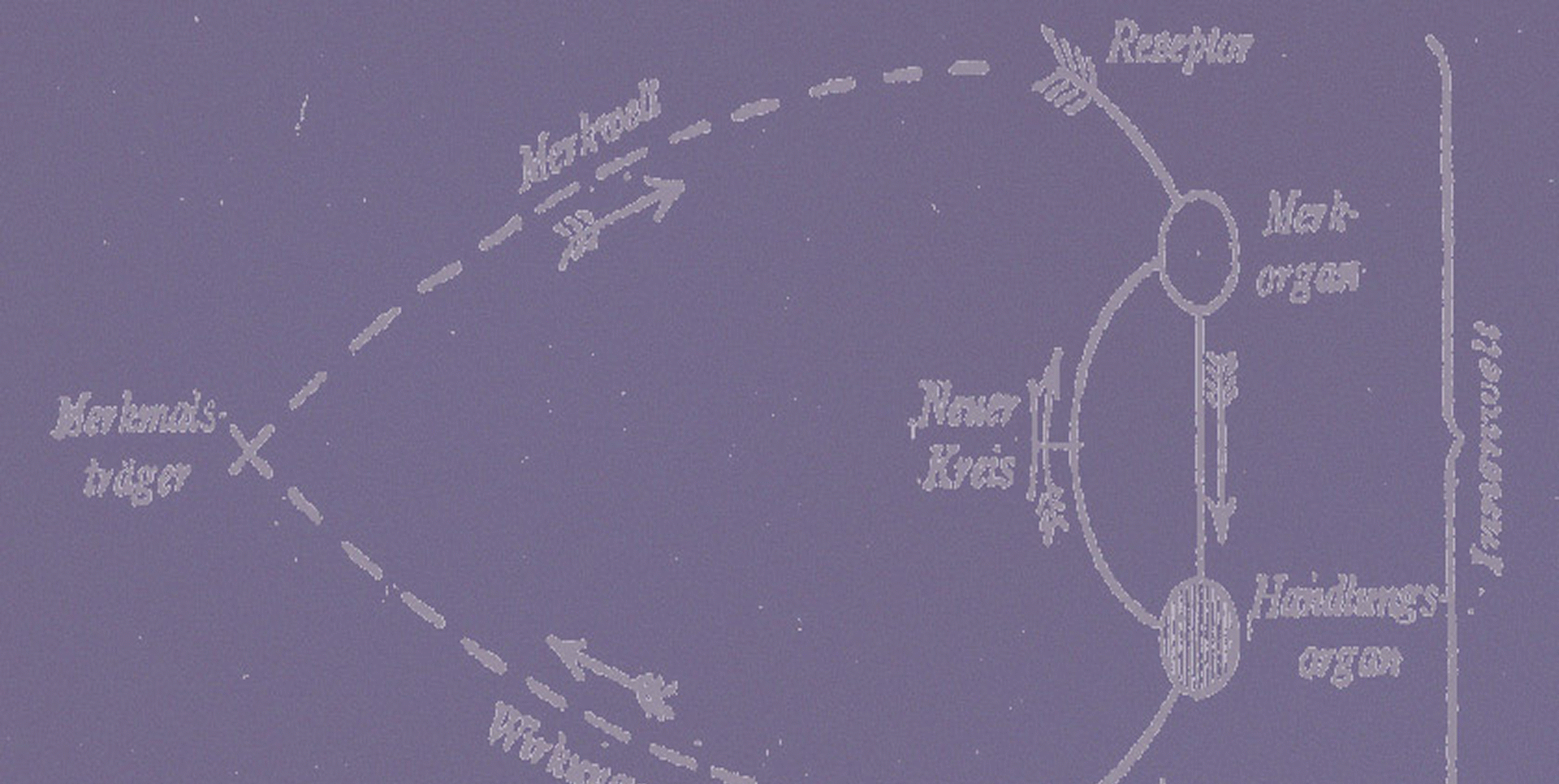
We bring our own categories and concepts into a world we believe we observe directly (Sagan in Uexküll, 1934/2010: 11)*. These categories act as filters that include or exclude what we consider significant. As a result, each of us lives in our own umwelt, or meaningful environment, which not only influences our perception, but also our creativity. The aim of this capsule is to discover the importance of freeing oneself from preconceptions and managing biases to develop new thinking structures.
* Uexküll, Jakob von. A Foray Into the Worlds of Animals and Humans: With a Theory of Meaning. New York, NY: University of Minnesota Press, 1934. https://b-ok.cc/book/1250205/533732.
Date: Tuesday, 18 November, from 5:30 pm to 8:30 pm
Location: Eina Bosc (clasroom B0)
Guest: Estampa. Artistic collective of programmers, filmmakers, and researchers based in Barcelona. Their practice is grounded in a critical and archaeological approach to audiovisual and digital technologies, with a particular interest in archives and experimental audiovisuals. Since 2017, one of their main lines of work has been the investigation of the uses and ideologies of AI. This interest began with the programmatically titled project The Bad Student. Critical Pedagogy for Artificial Intelligences, followed by more than twenty research projects, publications, installations, performances, and audiovisual works.
Problematising is a process of defamiliarisation that calls into question assumptions or beliefs that we take for granted. Problematising requires an inquisitive rather than responsive disposition, and involves working on ambiguity, nuance, and the ability to perceive things from different points of view. We will talk about and experience how we observe, and what it means to inquire and (re)define problems.
Date: Tuesday, 25 November, from 5:30 pm to 8:30 pm
Location: Aballí Studio or Eina Bosc (TBC)
Guest: Ignasi Aballí. Contemporary artist whose work moves between painting, photography, installation, and conceptual investigations of space. With a minimalist approach, Aballí explores perception, time and materiality through subtle gestures and everyday objects, questioning reality and its modes of representation. Since 1990, his work has been exhibited in institutions such as the Museu Serralves in Porto (2005), the Ikon Gallery in Birmingham (2006), the ZKM in Karlsruhe (2006), the Pinacoteca do Estado de São Paulo in Brazil (2010), Artium in Vitoria (2012), the Fundació Joan Miró in Barcelona (2016), the Art Museum of the National University of Colombia in Bogotá (2017), the Kula Gallery in Split (2018), and the Museum of Contemporary Art in Zagreb (2018). Among his retrospectives are those held at MACBA in Barcelona in 2005, Ignasi Aballí. 0-24 h, and at the Museo Nacional Centro de Arte Reina Sofía in Madrid in 2015, sin principio / sin fin. In 2022, he represented Spain at the Venice Biennale. His work is part of collections such as those of Artium in Vitoria, the Centre d’Art la Panera in Lleida, the Centro Andaluz de Arte Contemporáneo in Seville, the Museo Reina Sofía in Madrid and MACBA in Barcelona, among others. In 2020, to mark MACBA’s 25th anniversary, the artist donated the work Enderroc to the museum — a piece originally shown in one of MACBA’s first exhibitions, in 1996, and now permanently installed on one of the walls of the Meier building’s atrium.
Exploration is an active process of paying attention to the environment in search of information, discoveries, or learning. It depends on sensory perception and our ability to interpret signals in the surroundings. It involves bringing our senses into contact with stimuli that were previously neutral or indifferent (Berlyne, 1966) and immersing ourselves in them with the intention of better understanding them. Its value lies both in what is discovered and in the very process of discovery. Exploration does not always serve a specific goal; it often arises from the simple pleasure of doing it and becomes a source of learning and growth. It requires perceptual openness and receptivity, which distinguish it from rational analysis.
Date: Saturday, 29 November, from 5:30 pm to 8:30 pm
Location: PLANTA, Fundació Sorigué
Guest lecturer: Claudia Claremi makes films and explores the sensory language that makes image and sound possible, using various media such as video, analogue cinema, photography, archives, and performance.
The aim of this capsule is to expand perception, thus increasing the ability to aesthetically tune into an environment, perceive what is possible, and welcome it. We will focus on developing what we call “readiness status,” temporarily suspending reasoning, memory, evaluation, and expectations to give equal attention to everything observable.
Date: Tuesday,9 December, from 5:30 pm to 8:30 pm
Location: EINA Bosc (Classroom B0)
Guest: Ada Castells. Novelist and journalist. She has worked as a writer and columnist for the newspaper Avui and contributed to the culture section of La Vanguardia. She currently teaches creative writing courses and organizes creativity workshops. Her latest novels include La primavera pendent, Mare, and Solastàlgia, the latter adapted into a theatrical lecture format.
The capsule highlights that to articulate is also a creative act: by putting an idea into words, images, or gestures, we transform it and give it a new shape. We not only share what we think, but we also think differently thanks to the very act of expressing it.
Articulation is therefore a double process:
- Outward, as it facilitates communication and interaction with others.
- Inward, as it clarifies, sharpens, and expands our thinking.
In practice, we will explore how different modes of articulation —oral, written, visual, or performative— not only communicate but also generate new possibilities for understanding and creation, both individually and collectively.

