





Sausalito, construction without words (or also, Hammer and Nail Workshop) was the name given to an activity that was run at EINA in the 1972-73 academic year and that featured Fernando Amat and his students. The initiative consisted of making the students build a construction using recovered material and following specific guidelines set out by Fernando Amat. The material to be used was a heterogeneous set of waste that came from his warehouse (he took it all to the school gates in his van) and the work had to be done using basic tools – saw, hammer, nails, etc. – that Amat also provided. The most significant restriction,...
Sausalito, construction without words (or also, Hammer and Nail Workshop) was the name given to an activity that was run at EINA in the 1972-73 academic year and that featured Fernando Amat and his students. The initiative consisted of making the students build a construction using recovered material and following specific guidelines set out by Fernando Amat. The material to be used was a heterogeneous set of waste that came from his warehouse (he took it all to the school gates in his van) and the work had to be done using basic tools – saw, hammer, nails, etc. – that Amat also provided. The most significant restriction, though, was that the students and Amat, who took direct part in the activity, couldn’t talk to each other.
Fernando Amat is an essential name in understanding the phenomenon of the Vinçon shop, Barcelona design of recent decades and the culture of the object that spread from the 1970s. Amat collaborated in a number of activities done at EINA. The Sausalito proposal contained a critical attitude with regard to general cultural learning and the training of design students. The idea behind this construction sought to show – and it did, in fact, show – the distance that had been made between manual work, the difficulty of handling simple tools and the limitations of the project system of design.

Fernando Amat
"The people at the school," Amat recalls, "couldn’t do things with their hands." However, banning speaking highlighted other aspects. On the one hand, it denounced the hegemony of the word in the training process. On the other, it distilled the action of the creators into a collective improvisation, in the course of which all the builders interacted with individual decisions in a process where all dialogue or planning was absent.
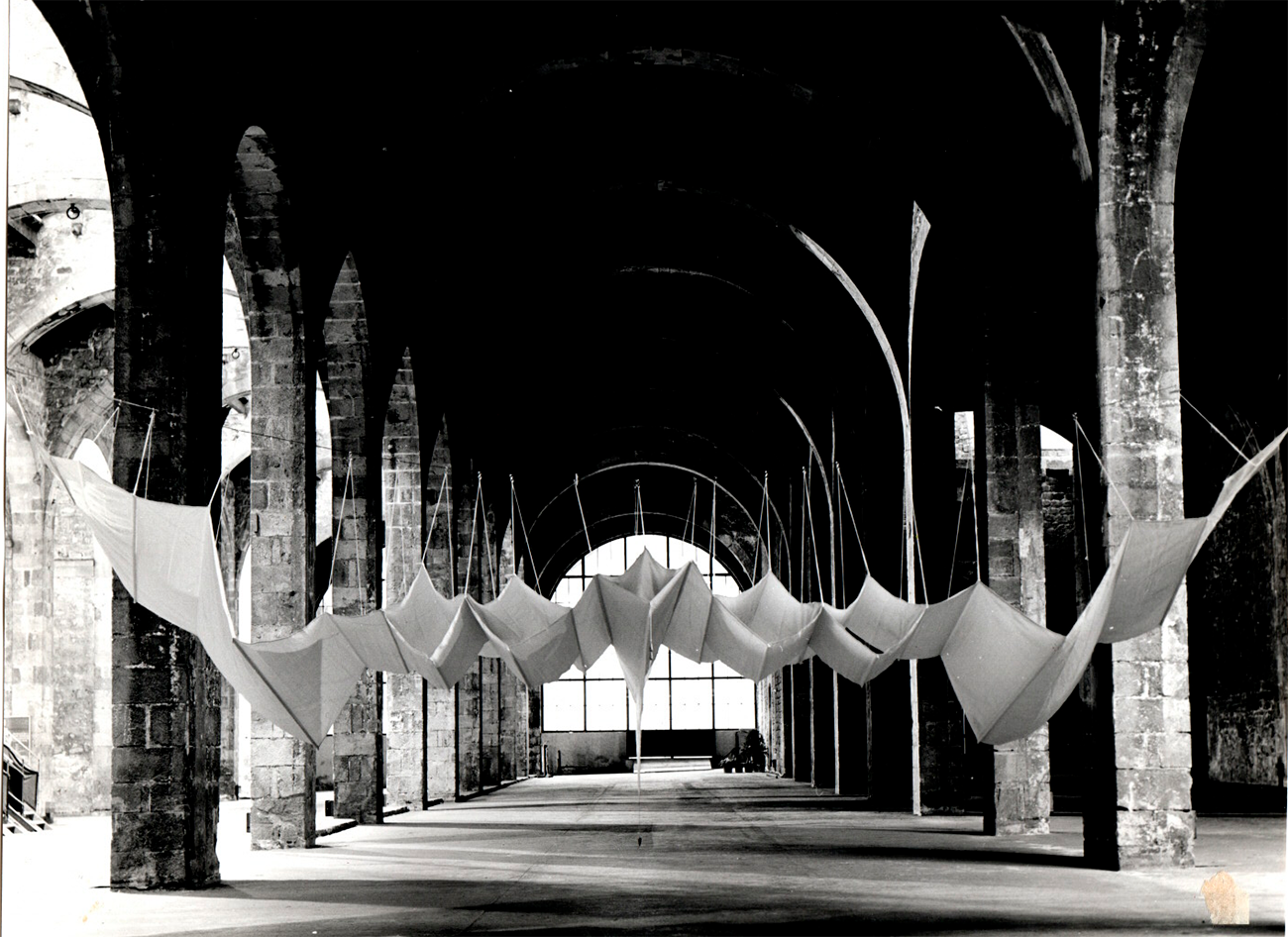
We have to place ourselves in the time of the incidence of semiotic theory and conceptual art, which was very evident at EINA. That same year, the school was the setting of other activities in which the following took part: Lluís Utrilla, Ponsatí, Carlos Pazos, etc. Therefore, the “action” by Fernando Amat was part of the trend of working in the environment of communicative experiences and the phenomenon of language. In Sausalito, meaning was deduced from this way of working without words and without a plan. If in the story of the Tower of Babel, the confusion of languages hindered construction, Sausalito succeeded, despite its precariousness, not through not understanding each other with words, but through completely doing away with them. The construction shown in the photograph is the result.

Text published originally in: Pibernat, Oriol. “Sausalito, construcció sense paraules. Curs 1972-73”. Plec: informatiu d’EINA magazine. No. 10 (Feb. 2002), p. 2.