




In the historical chronology of EINA we find a reference to a “[progressive music concert and montage and transformation of space]( (http://arxiu.eina.cat/index.php/audicio-de-musica-progressiva-i-muntatge-transformacio-de-lespai)” in 1973 that was organised by Pere Riera in collaboration with Jaume Sisaand some of the students from the school. For anyone under the age of sixteen in 1973, it may be...
In the historical chronology of EINA we find a reference to a “[progressive music concert and montage and transformation of space]( (http://arxiu.eina.cat/index.php/audicio-de-musica-progressiva-i-muntatge-transformacio-de-lespai)” in 1973 that was organised by Pere Riera in collaboration with Jaume Sisaand some of the students from the school. For anyone under the age of sixteen in 1973, it may be difficult to get an idea of the type of music and experiential search at that time, and its generational significance. As an expression of ethical and aesthetic concerns, music was an important means of identification and differentiation that acted as a catalyst for a longing for the transformation of the personal and social everyday; a longing that, particularly at that time, was highly accentuated. When Jaume Sisa gave his recital at EINA, it was right at the start of his career as a singer-songwriter. He’d come from Grup de Folk and had released his first solo single (L’home dibuixat, 1968) and, with the Música Dispersa instrumental group, his first album, Orgia, in 1971. Like other Catalan folk musicians, he was attracted to English-language rock. In the case of Sisa in the early 1970s, we can see the influence of the psychedelic folk and Gothic folk of groups like The Incredible String Band, together with a range of popular sounds from a variety of origins and lyrics that used the surreal and the oniric. The Barcelona of that time was seeing the beginnings of a counter-culture that called for new ways of living and relating with each other: young people who refused the “normality” of the previous generation, with a “hippy-freak” look, use of cannabis, parties at La Floresta, nights at Zeleste, and so on. With the unique cultural synchretism that characterised Barcelona at that time, these sorts of habits and ideas fitted in with those of a more urban counter-culture, with the micro-cultures characteristic of political affinity to parties of the left, with trendy liberals from boy scout backgrounds, with the snobbery of the gauche divine. All of these were phenomena that shared spaces and coexisted with the artistic and literary avant-garde circles or with the incipient sectors interested in design.

Jaume Sisa (1972-1973 academic year)
In the 72-73 academic year, EINA was a space with the windows open to many winds where a lot of these concerns circulated. It was a year of protest, where the syllabus was abandoned and students and teachers managed a great deal of experiences and activities for themselves. Conceptual performances would take on a more leading role than ever. Also, the counter-cultural anti-authoritarianism would make itself felt. Evidence of this is the trip to California organised and made that year (with the subsequent audiovisual session that had such a significant title as “California Dreamin’”), the “20,000 km by DKW across the USA” session told by Fernando Amat, and the appearance of the “Underboletín de EINA” journal, published by graphic design students and teachers, etc. It is in this context of music, trips and dreams that the other musical-sensorial experience in which Sisa took part occurred. Pere Riera, at that time a teacher on first-year interior design projects, was the driving force and responsible for decorating the space. The conference hall of the old school, in the Torre de Rubió i Bellver, was decorated with pop motifs, such as a cloud plinth, rainbows, etc. Thirty-two years later, Pere Riera offers a literary-documentary recreation of that experience in the text published below.

Cover of issue 2 of the Underground magazine (1973)
Recital by Jaume Sisa at EINA / Pere Riera
This is an exercise of memory, and as such we should know that it is only with the concentration of a tightrope-walker that we’ll avoid falling into the treacly trap of nostalgia. We’ll give it a go with the instruments of short-term memory: memories linked to the demands of action, and therefore subject to the speed that accompanies a lightning bolt and first aid. Intensity, solvency and compassion.
It was the 1973 academic year, the first year of interior design. There’s a possibility that Jaume Sisa would come and sing at the school. We decided to welcome him, as another exercise on the course, and we set to preparing the right organisational and atmospheric conditions for the recital to be a success. We choose the biggest space in the school: to be precise, the very classroom where we usually meet to learn, and where, with (ulls de farina rera el vidre, we delight in the contemplation of the enchanting garden that surrounds us.

Montage-transformation of the space by Pere Riera (1973)
Sisa’s recital will be in the evening. The groom, over little more than an hour, with his voice and a guitar, will fill the usual everyday working murmuring with sounds, and in doing so, will refresh the time of the party, the time that exceptionally alters and confirms the rule and constructs the rooms of memory. The bride, like all the guests, shivering between that desire for beauty that is confused with a promise of happiness, and that fear of inability that always eats away at us when we face the unknown, readies herself and readies the scene where (els amants del suquet de taronja i de l’arròs , for a brief moment, (jugaran a boles. Meanwhile, animated after-dinner discussions moisten the “sofas” and give way to sliding and concerns to see how the butterflies in flight are to be caught. Thoughtful observations of trajectories and a general concern to see how time passes and crosses over in company without hurting the susceptibility of anyone we care for (han obert la porta of the (cabaret galàctic for us, where (el carnaval de la república d’A will have to be consummated and consumed.
Learning to project far from the aesthetic and static eternity that usually accompanies immaculate interior design projects seems the only traversable route. Attached to the risk of everyday precariousness, restricted by the limitations of our own body, drawing a horizon able to be built with our hands and slurping horchata intensely with many lips at once, slipped, then, and warped, (els fills del mestre, once the (primera comunió al balcó disfressats de cavall has been done, get ready, not even for an instant, to enter into (el setè cel. Planning events, furnishing situations, capturing fluids, planting multiple memories in the garden of every conscience, and generating lasting emotions in the brief space of a few moments. In other words: learning to survive time well and constructing memorable facts and avoiding the risk, elsewhere so current, of becoming pillars of salt. Come the time, as though dazzled, all the plants in the garden stick their heads through the windows. They’re dressed as distant galaxies and expand the hearts and the space of the cathedral to the middle of the night that surrounds us.

Poster announcing the event on the EINA entrance door (1973)
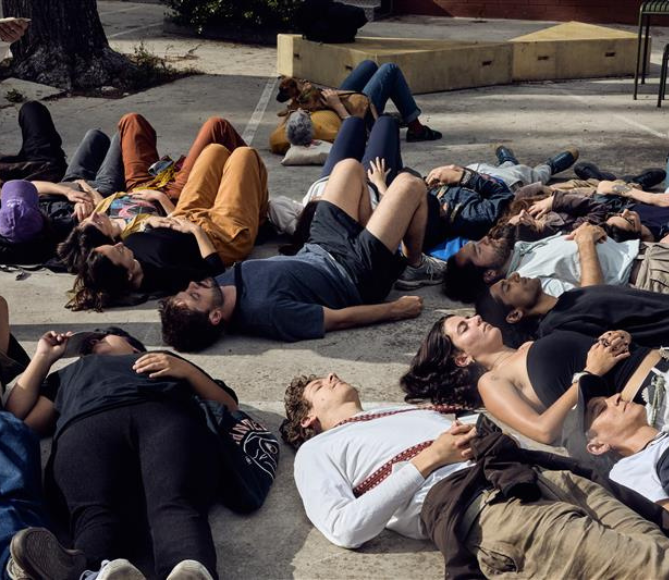
The groom, of a family of extremely rare insects facing extinction, lies imprisoned between two glasses: the glass in front, which is all of us, reflects an auditorium that, lying on a white carpet that has become separated from a starry sky, freezes his vision behind a protective white mask: an inversion of light that has turned the apparent material order of bodies upside down; the glass behind, which is what we all see, reflects a petrified and desiccated fauna that, laid out on a white marble slab, ignites his gaze with the fire of an inquisitive black mask. Between a life that is consumed and a material that burns, under the fire of many crossed masked gazes, that as butterflies fly and dance with the same lack of concern of cows at pasture, a curled and rhizomatous ginseng root, with gawky voice and absent eyes, unleashes a rosary of nonsense that has and makes sense of everything.
Finally, (la noia de Hawai, enrolment used up with no apparent methodological benefit, but with a gesture of complicity and of transparent knowing patience, runs away, turning her head and saying goodbye. She banishes herself from this world, (se’n va volant............ murmuring................................ (Reixes, patis i jardins, ara està tot desert. I les mans d’un escultor. Reixes, patis i jardins, ara està tot desert. Van caient pedres del cel.
(Ara és temps, és temps d’oblidar. Gemecs d’aquells que ahir van crear. La casa cau, s’apaga la llum. I el pas dels anys només deixa un record
(In white: excerpts from songs by Jaume Sisa)
Text published originally in: Pibernat, Oriol; Riere, Pere. “Music, travels and dreams of the counter-cultural EINA”. Plec: informatiu d’EINA. No. 17 (Nov. 2002), p. 3.