

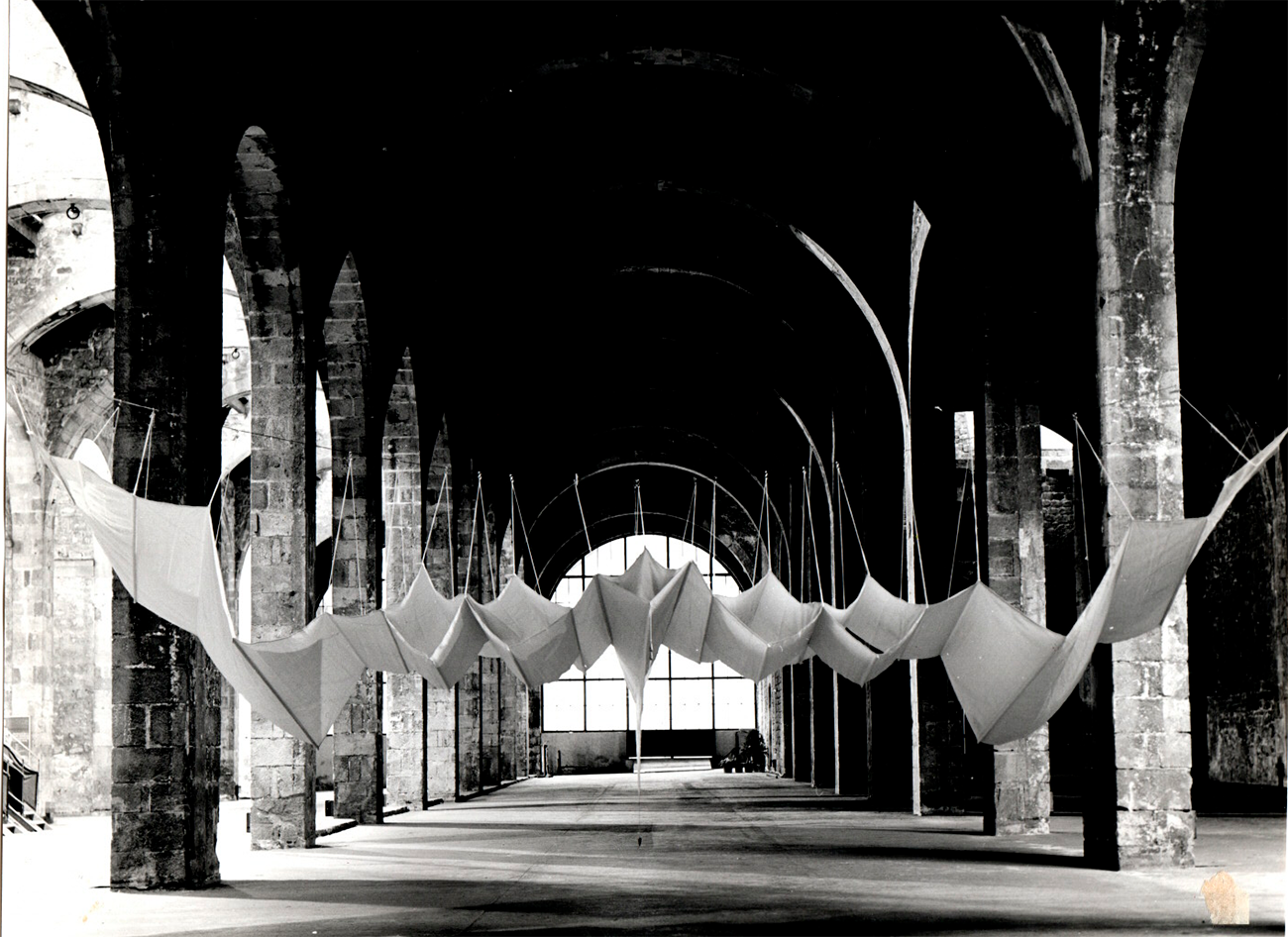
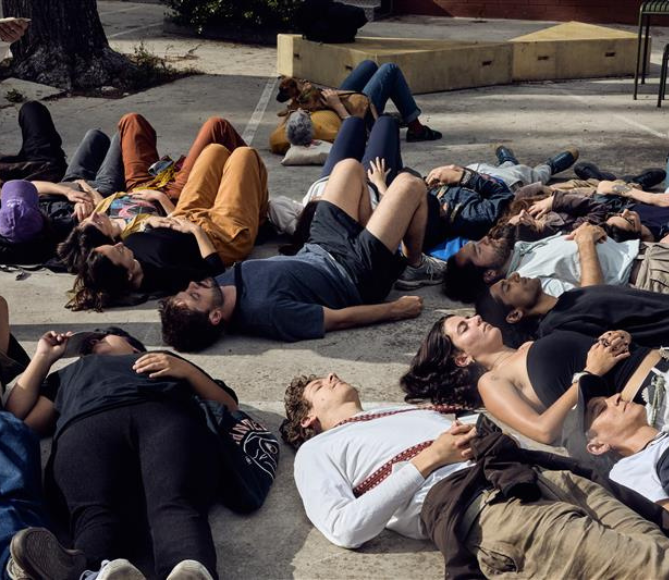


In his *Notes per a una història d’EINA* (Notes for a History of EINA), Albert Ràfols-Casamada describes the early days of EINA in detail and does not leave out the restoration of the old tower at the foot of the funicular railway. To ensure classes during the 1967-1968 year could start, minimum work was done on the facilities: “in terms of the building, the work by designer Joan Antoni Blanc, who designed an iron leg making it easy to take the tables apart and stack, was very important, as it made the school’s classrooms highly multi-purpose in nature. All the classrooms were painted white and the blackboards were installed. Lots of teachers also helped paint the legs on the tables. Finally, in mid-December, everything was ready. 1 As can be seen, the early days of EINA were marked by the excitement of the project and the scarcity of the resources. As Joan Antoni Blanc explains, he made full use of his contact with the Tortosa carpentry firm IMSA, to give him the doors – a sufficiently stable and light structure – which were used as table tops. At the same time, Blanc had numerous trestle tables made from iron pipes in a simple and effective design: two horizontal bars on which the table top rested and legs that formed a small arch at the upper part to support the wood. In short, an emergency and economic design that guarantees stability for work functions and light components that can be taken apart and stacked as required by the flexible uses of the classrooms.
 Students working in a classroom led by America Sanchez during the 1984-85 academic year.
During EINA’s early years, Joan Antoni Blanc was teacher of Design Projects and also of Morphology. He had previously worked at the FAD Design School and at Elisava, and from the moment EINA was founded, he was one of the main voices defending the need to incorporate technological knowledge and focus design on industrial applications. As the person principally in charge of the school’s facilities (in fact, others who also took part included Lelis Marquès, Pilar Mangrané, Anna Bricall, Dolors Cabasa and Camila Jubert), his design can be seen in other ways in the Rubió i Bellver Tower: he designed the suspended plastic-injection lights produced by Tramo, his first design, which won the 1968 Delta d’Or prize, and the shelves in the library and the secretary's office at the old school.
 (1980). Photography by Manel Esclusa.](/imatges/cavallets2-EINA.jpg) Trestle tables and lights designed by Joan Antoni Blanc. Exhibition Josef Albers: homage to the square, interaction of colour (1980). Photography by Manel Esclusa.
Trestle tables and lights designed by Joan Antoni Blanc. Exhibition Josef Albers: homage to the square, interaction of colour (1980). Photography by Manel Esclusa.
This post is a brief homage to the trestle tables, “and their creator”, as Blanc’s tables have been in the classrooms since that long-ago December 1967 right up until today in the mock-ups and prototypes workshop.
These trestle tables, which have been part of the EINA landscape and have accompanied its history, continue to be used as tables for specific events, and they serve to remind us of the longevity of this solution.
Notes
1 Villena, Josep Maria (coor.). EINA, Escola de Disseny i Art: 1967-1987, vint anys d'avantguarda. Barcelona: Government of Catalonia, Department of Culture, 1987.
Text published originally in: Pibernat, Oriol. “Un disseny amb història: els cavallets d’EINA de Joan Antoni Blanc”. Plec: informatiu d’EINA magazine. No. 21 (March-April 2003), p. 4.