




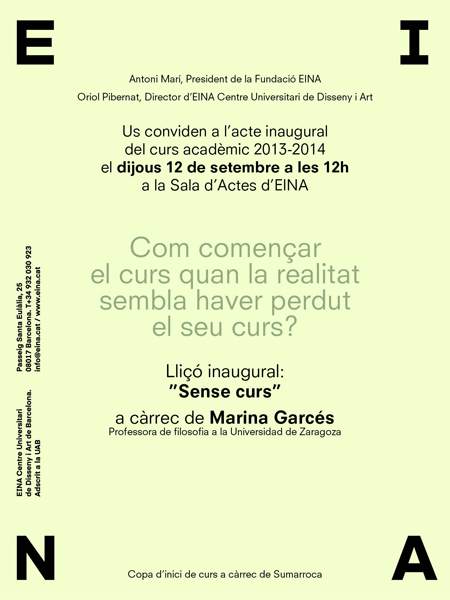
12/09/2013 12h at EINA's hall Inaugural Conference: ”Sense curs” by Marina Garcés
How do we start the course when reality seems to have gone completely off course? Normality and exceptionality have become confused and the horizon of expectations, even the most basic ones, namely continuity, have been levelled. In this crisis situation, the inevitable question of meaning rears its head: why learn? Why teach? Narratives supporting education practices have been broken. They lead nowhere. Therefore, standardised and competitive proposals dominate within institutional frameworks. The repetition of clichés and cynicism have the upper hand. This is why the desire to experiment with new frameworks, new formats and other ways of connecting with learning are emerging ever more forcefully. In these contexts, the question of meaning becomes the question of value: what value has teaching? What is the value of what I'm learning? This leads to the possibility of regaining the emancipatory power and commitment of education, which is not expanding our skills and knowledge, but making other ways of appreciating reality possible. Learning means relearning how to view the world. Educating ourselves means making ourselves more able to place value on it and ourselves freely. Education, be it formal or informal, has the possibility of redefining the meaning of wealth.
Marina Garcés (Barcelona, 1973) is a Tenured Lecturer in Philosophy at the University of Zaragoza. She also collaborates from time to time with the UOC and other local and international universities. She is also a member of the contemporary Philosophy Chair at the UB. She is the author of Un mundo común (2013) and En las prisiones de lo posible (2002), as well as numerous collective publications, ranging from the discontinued Archipiélago journal to her current monthly collaboration with the Nativa culture journal, and the newly-launched La maleta de Portbou. Last year, she also collaborated with the C33 TV programme "Amb filosofia". Her work takes place at the junction of political thought and contemporary aesthetics. Consequently, much of her public work has been undertaken in collaboration with institutions, such as the CCCB, MACBA and the UNIA-Arte y Pensamiento (Seville), to name but a few. Since 2002, she has promoted and coordinated the activities and publications of the Espai en Blanc collective project, dedicated to critical and experimental thought. In every field, be it academic or cultural, institutional or experimental, her work focuses on thought as a specific and established commitment to a common world. This is why all social practices that highlight the need for autonomy and cooperation are key.
 Opening Lecture 2013-14